

Stop Scoring Stores on Star Ratings. Score Them on How They Answer Reviews.

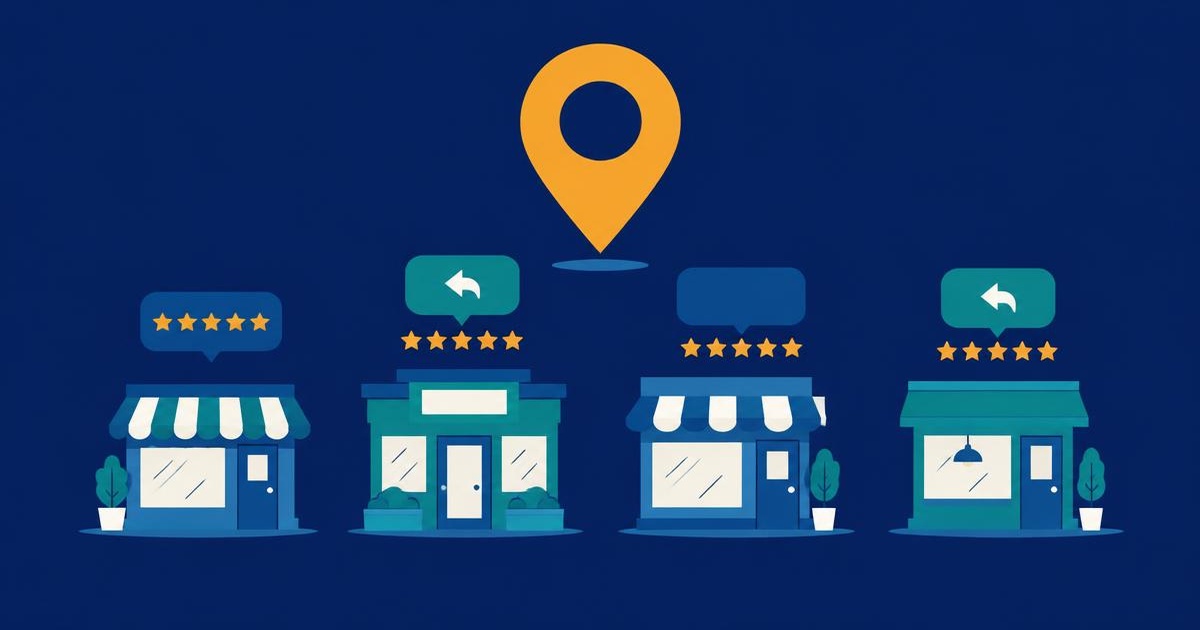
If your franchise scorecard ranks locations by star rating and review count, I'd retire both columns this quarter. Score each store on how fast and how specifically it answers the reviews it already gets, starting with the unhappy ones. And if any location pays, pressures, or sets quotas for staff to collect reviews, I'd shut that program down this month, before Google removes the reviews for you.
I've pushed for review volume myself. When we were building HomePro Marketing, more reviews looked like the fastest way to move a Business Profile, and for a brand-new location it often still is. But volume targets turn into contests, contests turn into staff asking guests at the counter for five stars and a shout-out by name, and Google's rules now prohibit that behavior in plain language.
Google wrote the review contest out of its rules
Google's Maps content policy spells out what merchants can't do when they ask for reviews. They can't offer payment, discounts, or free goods for a review, and they can't discourage negative reviews or ask only their happy customers. The policy also names two habits I see in a lot of franchise systems. Merchants can't ask staff to collect a certain number of reviews, and they can't ask staff to request reviews with specific content, including content that names an employee. Google says reviews that break these rules will be removed.
The federal side has teeth too. In December 2025, the Federal Trade Commission sent warning letters to 10 companies about possible violations of its Consumer Review Rule, which bars incentives conditioned on a positive or negative sentiment and requires disclosure when company insiders write reviews. The letters weren't findings of wrongdoing, but the FTC reminded recipients that violations can bring civil penalties of as much as $53,088 per violation.
The two standards differ, and that matters. The FTC targets incentives tied to sentiment. Google bans incentives for any review at all. A multi-location brand has to meet the stricter rule at every store. In a system with 200 locations, the bigger risk usually sits in a regional bonus plan written years ago that nobody has looked at since.
Build a reply ledger for 10 stores
Here's the method I'd run this week. It needs Business Profile access, a spreadsheet, and about three hours. I call it the reply ledger.
| Step | What you do |
|---|---|
| 1 | Pick 10 locations. Take your five busiest and your five lowest rated, so you see both ends of the system. |
| 2 | For each store, log the last 30 Google reviews with the star rating, the date posted, whether anyone replied, and the date of the reply. |
| 3 | Mark every reply as specific or canned. A specific reply responds to something the guest actually said. "Thanks for the kind words" with no detail counts as canned. |
| 4 | Calculate three numbers per store. The share of 1 to 3 star reviews answered within two business days, the share of replies that are specific, and the median days to reply. |
| 5 | Ask each general manager one question in writing. How do you ask guests for reviews, and is anyone rewarded for getting them? |
Then sort the stores. If a store answers fewer than half of its 1 to 3 star reviews within two business days, the fix is ownership. Name one person at that location who answers reviews and hold them to a 48-hour standard. If a store replies quickly but most replies are canned, the fix is quality, and a one-page guide with three real examples of good replies will do more than new software. If any manager describes a quota, a contest, a gift, or a script asking guests to name an employee, stop it that day, whatever the store's numbers look like.
Those thresholds are my judgment and don't come from an industry benchmark, so set your own before you open the data. Keep the results by location. A brand average of 4.4 stars can hide a store that hasn't answered a complaint since spring, which is why multi-location marketing needs measurement at the location level.
Why I'd rather fund the reply than the request
The best evidence I know on this comes from a study in Marketing Science, the peer-reviewed journal published by INFORMS. Davide Proserpio and Georgios Zervas examined tens of thousands of TripAdvisor hotel reviews and found that when hotels began responding, they received 12% more reviews and their ratings rose an average of 0.12 stars. Ratings didn't rise because guests were happier. They rose because unhappy guests became less likely to post baseless complaints once they could see a manager was paying attention, and the negative reviews that did come in got longer and more useful.
So replying earns you more reviews, which is what most volume programs are chasing anyway, without asking a single employee to hit a number. Google's own review tips for Business Profile owners point the same way. They tell owners to reply to reviews and to skip sending the same thank-you to everyone in favor of replies that answer a question or share an update.
Our own work points that direction too. In the home services portfolio we manage for Horsepower Brands, 14 of 15 GBP locations improved rankings through 25 to 40 automated actions per month, and review responses were one of those actions along with posts, Q&As, and videos. The details are in the Horsepower Brands case study.
That steady, store-by-store profile work is what our GBP PowerRank program is built around, and the consistency counts for more than any single burst of new reviews.
A chain's stars may not move its sales
Here's the strongest case against me. Michael Luca's Harvard Business School working paper on Yelp found that a one-star increase led to a 5% to 9% increase in revenue for independent restaurants, while ratings did not affect restaurants with a chain affiliation. If a known brand name already tells guests what to expect, a franchisee could fairly ask why reviews deserve any of their time.
I take that seriously, and it's one more reason I wouldn't chase the star average. But Luca's data comes from restaurants in Washington State, collected years before Google became the default place people check a store, and it measured the rating rather than the reply. A reply to a complaint about one store's slow drive-through tells the next guest that someone at that location knows about the problem. The brand name can't do that for you.
There are also cases where I'd keep asking for reviews hard. A new location with eight reviews needs more of them, and it should ask every guest the same neutral way, with a QR code or a receipt link. A store recovering from a wave of spam reviews needs fresh, genuine ones. Asking is allowed. Paying, pressuring, filtering, and setting quotas are what get you in trouble.
Where this evidence runs thin
The Marketing Science study looked at hotels on TripAdvisor, so treat its effect sizes as a direction for restaurants or home services on Google rather than a forecast. Luca's working paper studied one state and one platform. Our Horsepower Brands result bundles review responses with posts, Q&As, and videos, so I can't tell you how much of the ranking gain came from replies alone, and those responses were partly automated. I'd still have a person own every reply to a review under four stars.
Rankings also aren't sales. Connecting a better reply rate to revenue at a given store takes POS data, which is where our closed-loop attribution comes in for clients who opt in. Without that link, the ledger shows you which stores are listening. It can't put a dollar value on it.
Open one profile and count the replies
Before the end of today, open the Business Profile for your lowest-rated location and scroll back through its last 10 reviews under four stars. Count how many got a reply within two days. That number is the first row of your ledger, and it will tell you whether the rest of the week is worth doing.
Sources
- Google, "Prohibited & restricted content," Maps User Generated Content Policy Help, accessed November 10, 2026.
- Federal Trade Commission, "FTC Warns 10 Companies About Possible Violations of the Agency's New Consumer Review Rule," December 22, 2025.
- INFORMS, "Want to improve your business's online ratings? Make sure to respond to reviews," on Proserpio and Zervas in Marketing Science, September 8, 2017.
- Google, "Tips to get more reviews," Google Business Profile Help, accessed November 10, 2026.
- Michael Luca, "Reviews, Reputation, and Revenue: The Case of Yelp.com," Harvard Business School Working Paper No. 12-016, revised March 2016.
Brantley Smith
Chief Marketing & Product Officer, Triadex
Brantley Smith is Chief Marketing and Product Officer at Triadex, where he leads the marketing organization and the product platform, aligning client marketing performance with the systems that help multi-location brands grow at scale. He founded and scaled HomePro Marketing, building performance-driven marketing systems for franchise and multi-location brands before its acquisition by Triadex. His background spans agency leadership, SaaS product development, and B2B and B2C digital marketing strategy.
LinkedIn

Need help with your marketing?
Let's build a data-led marketing strategy tailored to your multi-location brand.
Talk to a Specialist