

Stop Renewing CTV on Completion Rates. Build a Dark Market Into Every Flight.

A 99% completion rate is not a result
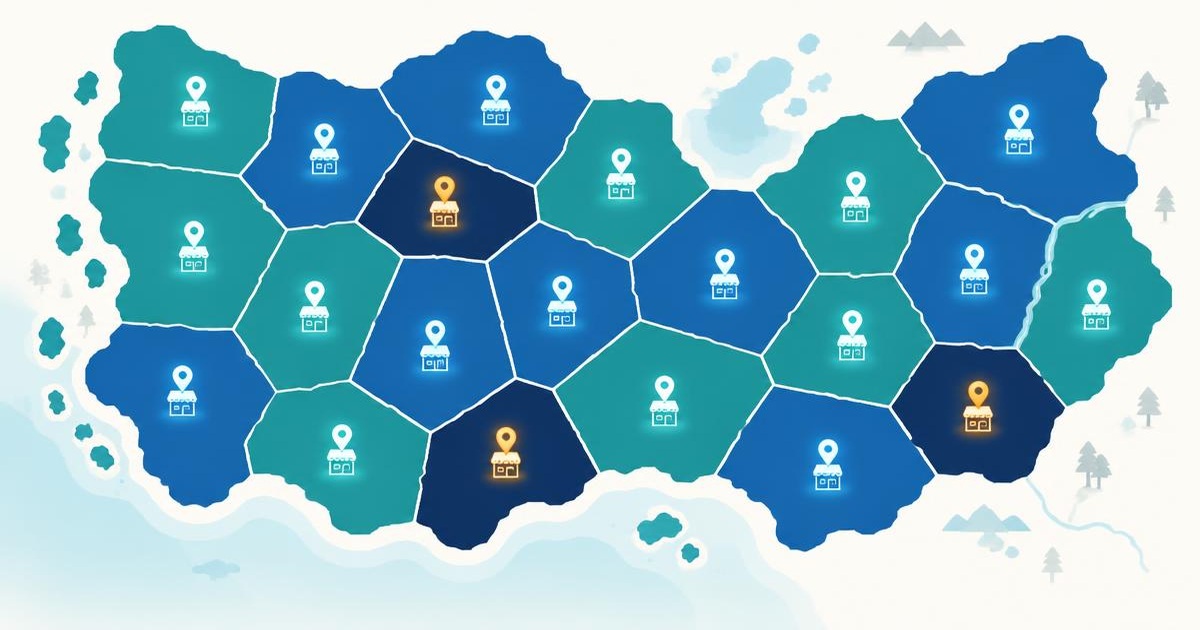
Multi-location brands should stop renewing connected TV because of completion rates. Every CTV flight you buy from here on should include a dark market, a planned group of locations whose trade areas get no streaming ads, so you can compare their sales with the stores that did. If a partner won't build one in, I'd move that budget to a channel you can measure store by store. That includes our own CTV work.
That's a hard line coming from a company that sells CTV. CTV is one of the most enjoyable channels to buy. The creative looks great on a living room screen, the delivery reports are clean, and the numbers are almost always high. That last part is the problem.
Two reports we were proud of
Here are two CTV results we've published ourselves. A national pizza brand franchisee with 4 locations ran CTV from August 1 to December 31, 2020, and its ads received over 200K completed views at a completion rate of 99.12%. The details are in the pizza franchisee CTV case study.
In the home services portfolio we manage for Horsepower Brands, programmatic CTV on local news broadcasts delivered 80K impressions at a 98.8% completion rate. That one sits inside the Horsepower Brands case study.
Both numbers are accurate. Neither tells you whether anyone bought a pizza or booked a roofer. The spots we run are non-skippable, so a completion rate near 100% mostly confirms that the ad played to the end on a screen that was switched on. It can't tell you who was in the room, whether they lived near a store, or whether they'd have bought anyway.
The pizza report did go a step further. It tracked in-store visits, which rose steadily through mid-November and stayed above average through the end of the campaign. That's a better signal than completion rate. It still had no comparison group, so I can't separate the CTV from the season or from the rest of the franchisee's standard marketing plan. The industry's default CTV scoreboard, ours included, measures delivery and calls it performance.
Why the stakes went up this year
The audience has moved. In its July 2026 report, Nielsen found streaming accounted for 49.0% of all U.S. TV viewing, ahead of broadcast at 19.5% and cable at 18.7%. Budgets are following. The IAB projects U.S. digital video ad spend will pass $80 billion in 2026, with CTV growing 11%.
Buyer confidence hasn't kept up. In the second part of the same study, the IAB found 43% of buyers had somewhat to no confidence in the quality of the CTV inventory they buy, even through the most trusted methods like direct insertion orders and programmatic guaranteed. For the open exchange, that figure rose to 67%.
Then there's the measurement method itself. Researchers writing in Marketing Science compared 15 U.S. advertising experiments at Facebook with the observational methods the industry commonly uses, and found those methods often failed to produce the same effects as the randomized experiments. That study looked at social ads, not streaming. The lesson still carries over. Reporting that matches people who saw an ad to people who later showed up can tell a different story from a controlled test, and without a control you won't know which way it's off.
For a franchise system or a dealer network, the problem compounds. One DMA can hold a dozen of your locations with very different trade areas, and a brand-level lift number averages the store that gained with the one that didn't. Location-level marketing needs location-level measurement. That's why our connected TV planning starts from each store's trade area instead of a national spot.
When I'd buy CTV without a holdout
There are fair cases. A brand opening in a new DMA, where nobody knows the name yet, can reasonably buy CTV for reach and judge it later on awareness and branded search. A system with 3 or 4 locations in one market may not have enough stores to hold any out without starving one of them, and our pizza franchisee is a fair example. Live sports is another. The same IAB research found 93% of buyers agree live content is worth more than other video, and a big game in your market can be worth buying for the audience alone.
Even then, I'd write down before launch what result would make you stop. Skipping the holdout is sometimes reasonable. Skipping the decision rule never is.
The dark-week comparison
You can run this on CTV you've already bought, in about a week, with data you already have.
1. Pull two files
Ask your CTV partner for the last six months of delivery by week and by DMA or ZIP code. Then export weekly sales or transaction counts by location from your POS.
2. Tag every store-week
For each location, mark each week as on, meaning its trade area received CTV, or dark. Most brands find natural dark weeks between flights and whole markets that never got streaming ads.
3. Compare the change, not the level
For stores in CTV markets, find the average difference in weekly sales between on weeks and dark weeks. Then calculate the same difference for stores in markets with no CTV over those same weeks. The second number shows what the season did by itself.
4. Apply the rule
If CTV stores rose more in on weeks than non-CTV stores did over the same weeks, and the gap is bigger than your normal week-to-week swing, CTV has earned a formal test. If the gap sits inside the normal swing, it hasn't proven itself yet. If you have no dark weeks or no untouched markets, you have no evidence in either direction, and that's a finding too.
5. Write the dark market into the next order
Before the next flight, pick two or three markets whose stores match your CTV markets on sales and size, and keep them dark on purpose for the whole flight. Next quarter's report stops being a delivery summary and starts answering the question you're paying to answer.
The rough edges of this test
This comparison is rough. Markets differ in weather, competition, and local promotions, and a franchisee who runs a big local offer during an on week will skew it. Store visits measured from mobile location data are modeled estimates, not counts. Nielsen's share figures include ad-free viewing, so not all of that 49.0% is buyable. And a dark market has a cost, because those stores give up a flight of reach so the rest of the system can learn.
CTV may also make the next mailer or search ad more familiar, and a short sales window won't capture that. I can't prove it from a four-week comparison, and I won't pretend to. Our closed-loop attribution through LOOP is planned to connect CTV exposure to POS transactions by the end of Q1 2027, and it isn't generally available for CTV today. Until a client has it, we report delivery as delivery and say plainly that it isn't proof of sales.
Before Friday
Open your last CTV report and find the completion rate. Then send your partner one question. Which of our markets got no CTV during that flight, and how did those stores do? If nobody can answer it, that's the first thing to fix.
Sources
- Nielsen, "TV Usage Kicks Usual Summer Slowdown, Fueled by World Cup and Streaming in Nielsen's July Gauge Reports," September 10, 2026.
- IAB, "U.S. Digital Video Ad Spend to Surpass $80B in 2026; Growing 20% Faster Than the Total Ad Market, According to IAB," May 5, 2026.
- IAB, "Business Outcomes Are Just the Beginning, According to IAB Digital Video Ad Spend & Strategy Full Report," July 14, 2026.
- Gordon, Zettelmeyer, Bhargava, and Chapsky, "A Comparison of Approaches to Advertising Measurement: Evidence from Big Field Experiments at Facebook," Marketing Science (INFORMS), 2019.
Brantley Smith
Chief Marketing & Product Officer, Triadex
Brantley Smith is Chief Marketing and Product Officer at Triadex, where he leads the marketing organization and the product platform, aligning client marketing performance with the systems that help multi-location brands grow at scale. He founded and scaled HomePro Marketing, building performance-driven marketing systems for franchise and multi-location brands before its acquisition by Triadex. His background spans agency leadership, SaaS product development, and B2B and B2C digital marketing strategy.
LinkedIn

Need help with your marketing?
Let's build a data-led marketing strategy tailored to your multi-location brand.
Talk to a Specialist